
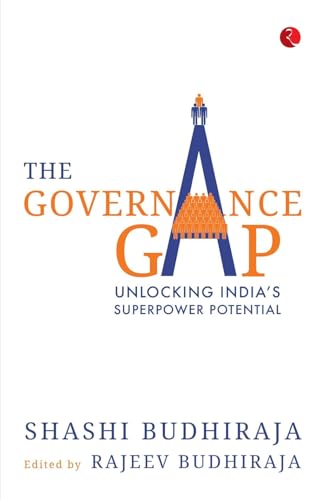
Governance gap: unlocking India’s superpower potential
Material type: TextPublication details: New Delhi Rupa Publications 2025Description: 283 pISBN:
 - 9789370037175
- 320.954 BUD
| Item type | Current library | Call number | Status | Date due | Barcode | Item holds |
|---|---|---|---|---|---|---|
 Books
Books
|
Gandhi Smriti Library | 320.954 BUD (Browse shelf(Opens below)) | Available | 185518 |
Browsing Gandhi Smriti Library shelves Close shelf browser (Hides shelf browser)

|
No cover image available No cover image available |

|

|

|

|

|
||
| 320.954 BHO Design thinking for resurgent Bharat | 320.954 BRA Language, religion and politics in North India | 320.954 BRA 2nd ed Politics of India since Independence | 320.954 BUD Governance gap: unlocking India’s superpower potential | 320.954 CAL World Politics: 1945-2000 | 320.954 Cal 5th ed. World politics since 1945 | 320.954 CHA Changing face of India : essays in honour of Balraj Puri / edited by Ved Bhasin and Om Prakash Saraf |
What will it take to unlock India’s true growth potential? The answer is robust institutions and good governance.
Even though India is the world’s largest democracy, is real power held by its people or by those who govern them? How well are we managing the dreams and aspirations of 1.4 billion Bharatiyas? What does the future hold for India? Has the political class delivered on its promises? Is the bureaucracy capable of quick changes? Will governments ever break free of political compulsions and place citizens’ objectives as their central objective? India is acknowledged globally for its capacity to hold regular, peaceful elections—but are they free of the influence of money and muscle power? Have legislatures forgotten their basic role of monitoring the government?
Shashi Budhiraja is well-placed to pose these timely questions. As a former technocrat who has steered many a private sector and government institution, with stints for the World Bank and UN, he has gained a comprehensive view of the workings of the system. In this book, he probes the vital gaps in the architecture of governance and those within institutions. He also examines policies framed for fundamental sectors such as agriculture, education and health to highlight the trend of governance deficit over time.
Budhiraja provides a blueprint for course-correction that will unlock India’s potential, arguing that it needs but one attribute—political will to place citizens’ concerns as the central objective.
There are no comments on this title.